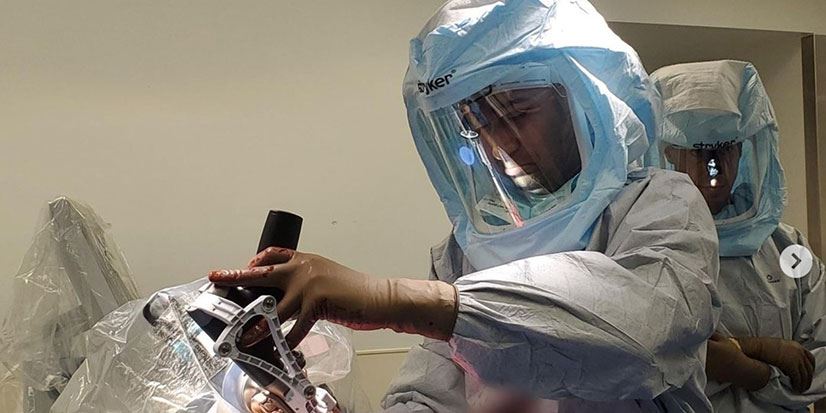


Baker's Cyst Treatment
Baker’s cyst treatment depends on the cyst's size, symptom severity and the underlying knee condition causing excess fluid to accumulate.
Baker's Cyst Treatment Options
How to treat a Baker's cyst varies according to the severity of symptoms and the knee problem responsible for excess fluid production.
Nonsurgical Baker's Cyst Treatment
Even a ruptured Baker's cyst often heals with conservative treatment, although sudden calf pain or swelling requires prompt medical evaluation to rule out a blood clot.
Nonsurgical Baker’s cyst treatment options include:
- Home care: Rest, ice, compression and elevation (RICE) help reduce pain and swelling. Avoid activities that aggravate symptoms.
- Medication: Over-the-counter pain relievers and anti-inflammatory medications can reduce discomfort.
- Physical therapy: Stretching and strengthening exercises improve knee mobility and function.
- Corticosteroid injections: Injections into the knee joint reduce inflammation and may decrease fluid production.
- Ultrasound-guided aspiration: A specialist uses a needle to drain fluid from the cyst, relieving pressure and swelling.

Baker's Cyst Treatment At A Glance
Baker's cyst treatment relieves pain and swelling behind the knee by reducing excess joint fluid and treating the underlying knee condition.
- Used to treat: Painful, swollen or persistent Baker's cysts (popliteal cysts).
- What to expect: Home care, physical therapy, medication, injections or fluid drainage. In some cases, surgery is required to address the underlying cause.
- Recovery typically includes: Reduced swelling, improved knee mobility and a gradual return to normal activities. Recovery time depends on the treatment and underlying condition.
- You may be a candidate for Baker’s cyst treatment if: Your popliteal cyst causes persistent pain, swelling, stiffness or difficulty moving your knee.
Frequently Asked Questions
-
Your knee specialist will review your symptoms and medical history, then examine your knee for swelling, tenderness and limited mobility. Imaging tests such as ultrasound or MRI may be recommended to confirm the diagnosis and identify underlying knee problems. Together, you'll discuss treatment options and develop a personalized care plan.
-
A ruptured Baker's cyst typically causes sudden pain and swelling as fluid leaks into the calf. Symptoms include:
- Sudden pain behind the knee or in the calf
- Swelling and tightness extending down the lower leg
- A sensation of warm fluid running down the calf
- Bruising or discoloration around the calf or ankle
- Difficulty walking or bearing weight
Because these symptoms can resemble deep vein thrombosis (DVT), a potentially dangerous blood clot, seek prompt medical evaluation.
-
Baker's cysts may last several weeks to several months. Some resolve on their own, while others persist or recur, especially when an underlying knee condition continues to produce excess fluid.
-
Yes, a Baker's cyst can go away on its own. If the excess fluid production decreases, the body may gradually reabsorb the fluid in the cyst, allowing it to shrink or disappear without treatment.
Articles Related to Baker's Cyst
-

- Sports Medicine
A bad landing, a sharp pivot, a missed step, a hard collision — sports can put enormous stress on the knees and ankles. From ACL tears and meniscus ...
Read Blog -

- Sports Medicine
A sports injury is damage to the body affecting muscles, ligaments, tendons, or bones, caused by acute trauma or repetitive stress during physical ...
Read Blog -
- Blog
- Hip
- Knee
- Shoulder
- Spine
As one of the only dedicated spine and orthopedic surgical hospital and ambulatory surgery center networks on the West Coast, Hoag Orthopedic ...
Read Blog -

- Knee
- Sports Medicine
Knee pain can happen for a variety of different reasons. We spoke with HOI orthopedic surgeon, Dr. Taylor Dunphy, to discuss the most common causes of ...
Read Blog -

- Blog
- Hip
- Knee
Your orthopedic surgeon says, after perhaps months or years of treating your hip or knee pain, that conservative treatment is no longer working. The ...
Read Blog



What Our Patients Say
-
 Back to Life in Motion After Six Joint Replacements Hip
Six New Joints, One Unrelenting Drive to Remain in Constant Motion Hoag Orthopedic Institute ...
View Story -
 Back to Providing Physical Therapy Knee
At a professional conference last year, HOI Physical Therapy Supervisor Jen Brandon, PT, MPT, ...
View Story -
 Back to a Family Christmas Knee
My wife, Lucille, was admitted to the Hoag Orthopedic Hospital, Irvine, California for total knee ...
View Story -
 Back to the Golf Course Hip
Shooting pain down the leg. Too painful to stand more than minutes. Sitting up to sleep and resting ...
View Story -
 Back to Work Knee
For the past 25 years, Rodolfo Franco of Santa Ana has been lifting and moving furniture and ...
View Story -
 Back to Mobility and Me Knee
Procedure: Bilateral Total Knee Arthroplasty Seeing the world from the back of a Gold Wing ...
View Story -
 Back to Cooking Knee
“If I hadn’t had my knee replaced, I wouldn’t be out and about – I would be home in bed. Now I can ...
View Story -
 Back to Racing Knee
Racecar driver Danny Thompson, 67, set the national land speed record at 406.7 mph in August 2016. ...
View Story -
 Back to Skiing and Snowboarding Knee
Rick Rengel, age 58, was having a great time speeding down a ski slope in Utah in 2013 when he hit a ...
View Story -
 Back to Golf After Knee Replacement Knee
Retired dentist Dr. Gregory Cramm and his wife, Cathy, enjoy going out for a nice dinner and glass ...
View Story -
 Back to Skiing Sports Medicine
Procedure: Simultaneous Bilateral Total Knee Arthroplasty (SBTKA) – October 2016 Gaelyn’s knees were ...
View Story -
 Returning to Boxing After Surgery Sports Medicine
Procedure: Right Total Knee Arthroplasty When Brad retired nearly 20 years ago at age 52 from a ...
View Story -
 Back to Gardening Knee
Verna’s days are much more fruitful after having repairs to both knees. For the first time in more ...
View Story -
 Back to Living Fully After Knee Surgery Knee
Dr. Jorge Rodriguez lives an active lifestyle in Los Angeles where he sees dozens of patients during ...
View Story




.2510151138550.jpg)