Quadriceps and Patellar Tendon Tear
If you are an athlete, especially when it comes to playing basketball or tennis, you rely on complex components of the knee to aid you in jumping, cutting, and sudden rapid movements. That is when the patellar tendons and quadriceps tendons serve a vital function. If you suffer a patellar tendon tear or a quadriceps tendon tear, you’ll likely need to pause your athletic activities until you receive knee treatment and fully recover.
The extensor mechanism is made up of the quadriceps muscle, quadriceps tendon, patella, patellar tendon, and tibia. The main function of the patellar tendon and the quadriceps tendon is to straighten the knee, which is essential for walking. The quadriceps tendon is the attachment of the quadriceps muscles to the patella (knee cap), and the patellar tendon is the attachment from the patella (knee cap) to the tibia (shin bone) (Figure 1).
At Hoag Orthopedic Institute, our knee doctors and surgeons specialize in repairing patellar tendon tears and quadriceps tendon tears so that you can get back in the game.
What is a Patellar Tendon Tear?
A patellar tendon tear may occur due to a forceful contraction of the quadriceps while running, kicking or jumping. It can also be torn by falling directly on the kneecap. In both cases, the tear can be partial or completely ruptured (torn fully). A small patellar tendon tear can make it difficult to walk and perform other daily activities. A larger patellar tendon tear, however, can be quite disabling and usually requires surgery and physical therapy to regain full knee function.
What is a Quadriceps Tendon Tear?
The quadriceps tendon most often tears due to a sports injury, joint weakness or an underlying chronic knee condition. Injury typically arises when the knee is bent and under heavy load. Besides pain, a popping sensation usually accompanies a quadriceps tendon tear.
Even a small quadriceps tendon tear can make walking difficult. If the tendon ruptures, the muscle is no longer connected to the kneecap. Already weakened quadriceps tendons are more likely to tear or rupture.
Quadriceps and Patellar Tendon Tear Symptoms
Patellar tendon tears and quadriceps tendon tears occur when the quadriceps tendon contracts suddenly, with force exceeding the capacity of the tendons, often as a result of jumping during sport or falling on a flexed knee. A patellar tendon rupture or quadriceps tendon rupture consisting of a full tear is commonly found in patients with pre-existing tendon degeneration/tendinosis.
Patellar tendon tear symptoms may include acute pain around the knee cap, often with an associated popping noise. The knee typically has significant swelling after rupture. Patients will have difficulty extending the knee and walking after the injury.
Quadriceps and Patellar Tendon Rupture Diagnosis
A clinical exam is central to the diagnosis of the patellar tendon and quadriceps tendon tear or rupture. A palpable gap is often felt at the respective tendon site. The surgeon will test the competence of the extensor mechanism by asking the patient to perform a straight leg raise against gravity; if the patient cannot extend the knee, a significant quadriceps or patellar tendon tear is likely.
When the patellar tendon ruptures, the knee cap will be significantly elevated (patella alta) compared to the normal knee (Figure 2). In a quadriceps tendon rupture, the knee cap will be slightly lower (patella baja).
Additional imaging studies are used to help confirm the diagnosis:
- X-rays can be helpful in determining the location of the extensor mechanism disruption.
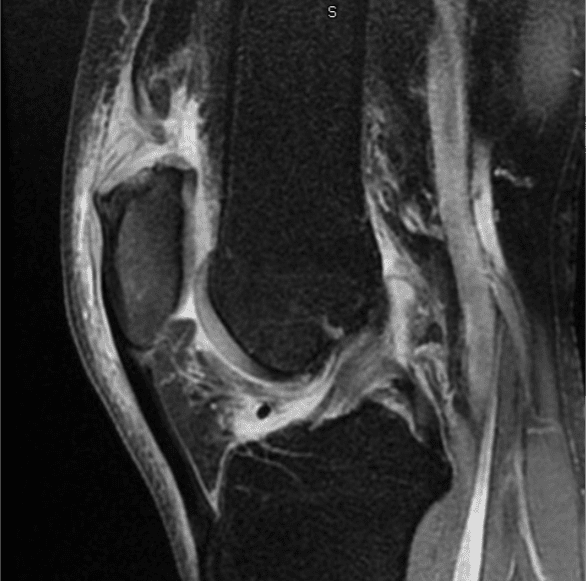
- MRI is often used to confirm diagnosis and can help characterize tear patterns, underlying tendon disease, and any associated injuries (Figure 3).
Treatment Options for Quadriceps and Patellar Tendon Tears
Options for treating a patellar tendon tear or a quadriceps tendon tear depend on whether a tear or actual rupture occurred.
Nonsurgical Treatment for Patellar Tendon Tears and Quadriceps Tendon Tears
Partial patellar and quadriceps tendon tears may be treated conservatively if patients continue to have the ability to extend the leg. Conservative treatment for a patellar tendon tear or a quadriceps tendon tear may include the following:
- Rest and modification/avoidance of activities that will aggravate your knee pain
- Applying ice to the affected area
- Over-the-counter non-steroidal anti-inflammatory drugs (NSAIDs) for pain and swelling reduction (such as ibuprofen)
- Physical therapy to improve mobility flexibility and decrease pain
- Knee brace to rest the affected muscles and tendons
- Corticosteroid injections to relieve symptoms
Surgical Treatment for Patellar Tendon Rupture and Quadriceps Tendon Ruptures
Complete patellar tendon ruptures and complete quadriceps tendon ruptures require surgical intervention because, without repair, patients will be unable to extend the leg or support themselves when walking.
When to See a Doctor for Knee Tendon Tear
Because a knee tendon tear can often cause pause and may make walking difficult, it is crucial to see a doctor as soon as possible. You need a patellar tear diagnosis before proper treatment can start. If you have a patellar tendon tear or a quadriceps tendon tear or rupture, our board-certified, fellowship-trained knee surgeons will build a custom treatment plan to help you get back to doing the things you love doing.
Hoag Orthopedic Institute is ranked as one of the top Orthopedic Hospitals by U.S. News & World Report in 2024-2025. Contact Hoag Orthopedic Institute today to schedule a consultation with one of our knee doctors.
Figure 1: The Extensor Mechanism of the Knee
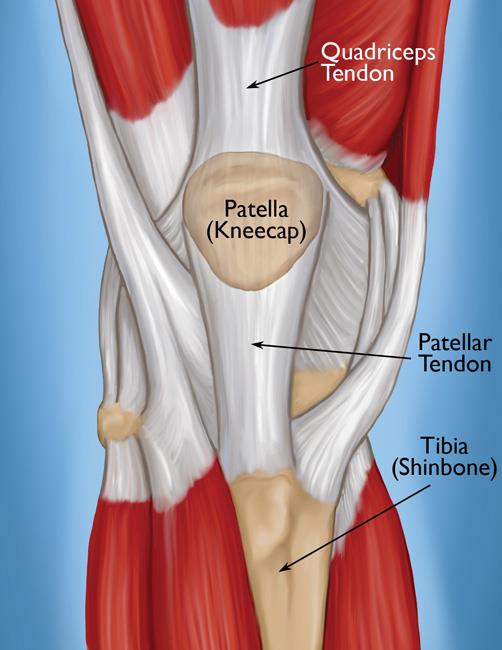
Figure 2: X-ray demonstrating patella alta due to patellar tendon rupture
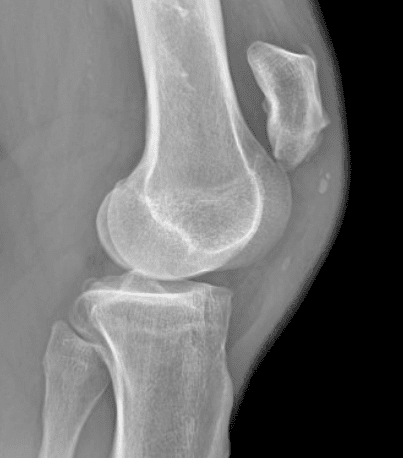
Figure 3: MRI of a quadriceps tendon rupture
Find a knee surgeon that treats patellar tendon tears and quadriceps tendon tears. Call us at (949) 705-6493 to make an appointment.
-
 Returning to Boxing After Surgery Knee, Sports Medicine
"Procedure: Right Total Knee Arthroplasty When Brad retired nearly 20 years ago at age ..."
Read More -
Back to Mobility and Me Knee
"Procedure: Bilateral Total Knee Arthroplasty Seeing the world from the back of a Gold ..."
Read More -
Back to Skiing Knee, Sports Medicine
"Procedure: Simultaneous Bilateral Total Knee Arthroplasty (SBTKA) – October 2016 ..."
Read More -
Back to Gardening Knee
"Verna’s days are much more fruitful after having repairs to both knees. For the first ..."
Read More -
Back to Golf After Knee Replacement Knee
"Retired dentist Dr. Gregory Cramm and his wife, Cathy, enjoy going out for a nice ..."
Read More -
Back to Racing Knee
"Racecar driver Danny Thompson, 67, set the national land speed record at 406.7 mph in ..."
Read More -
Back to Skiing and Snowboarding Knee
"Rick Rengel, age 58, was having a great time speeding down a ski slope in Utah in ..."
Read More -
Back to Cooking Knee
"“If I hadn’t had my knee replaced, I wouldn’t be out and about – I would be home in ..."
Read More -
Back to a Family Christmas Knee
"My wife, Lucille, was admitted to the Hoag Orthopedic Hospital, Irvine, California ..."
Read More -
Back to the Golf Course Knee
"Shooting pain down the leg. Too painful to stand more than minutes. Sitting up to ..."
Read More